Now let me tell you something about this string, and I mean really tell you, not the way the marketing department tells you, with their waterfall photography and their fonts that cost more than a polymer chemist's monthly wage.
I am holding a set of Volkl Cyclone Tour in 18 gauge, which for those of us who learned our measurements from the people who actually measure things rather than the people who commission the measuring, that is approximately 1.20 millimetres in diameter.
A single set runs around 12 metres, give or take, enough to string one racket, and the hands that feed that string through the grommets belong to someone, and I want us to remember that someone while we talk.
Now, polyester strings do not grow on trees, and they certainly do not string themselves. Someone in a facility, somewhere in the supply chain, drew this filament, shaped it, gave it that distinctive five-sided star-shaped cross-section that Volkl engineered into the Cyclone line. That pentagonal profile is not decorative whimsy.
The material is a co-polyester monofilament.
It is functional geometry. The edges bite into the ball on contact, generating spin at a rate that will make your opponents quietly furious. Topspin players, heavy hitters, people who want the ball to dip and kick and do the kind of things that make a returner rethink their life choices — this is the string that does that work.
The Tour designation, as opposed to the standard Cyclone, indicates a slightly firmer, lower-powered response, which suits the player who already generates their own pace and wants the string to translate effort into control rather than add unearned amplification. A grinder.
A baseliner with a big swing arm.
Someone who put in the hours on court and wants the equipment to respect that.
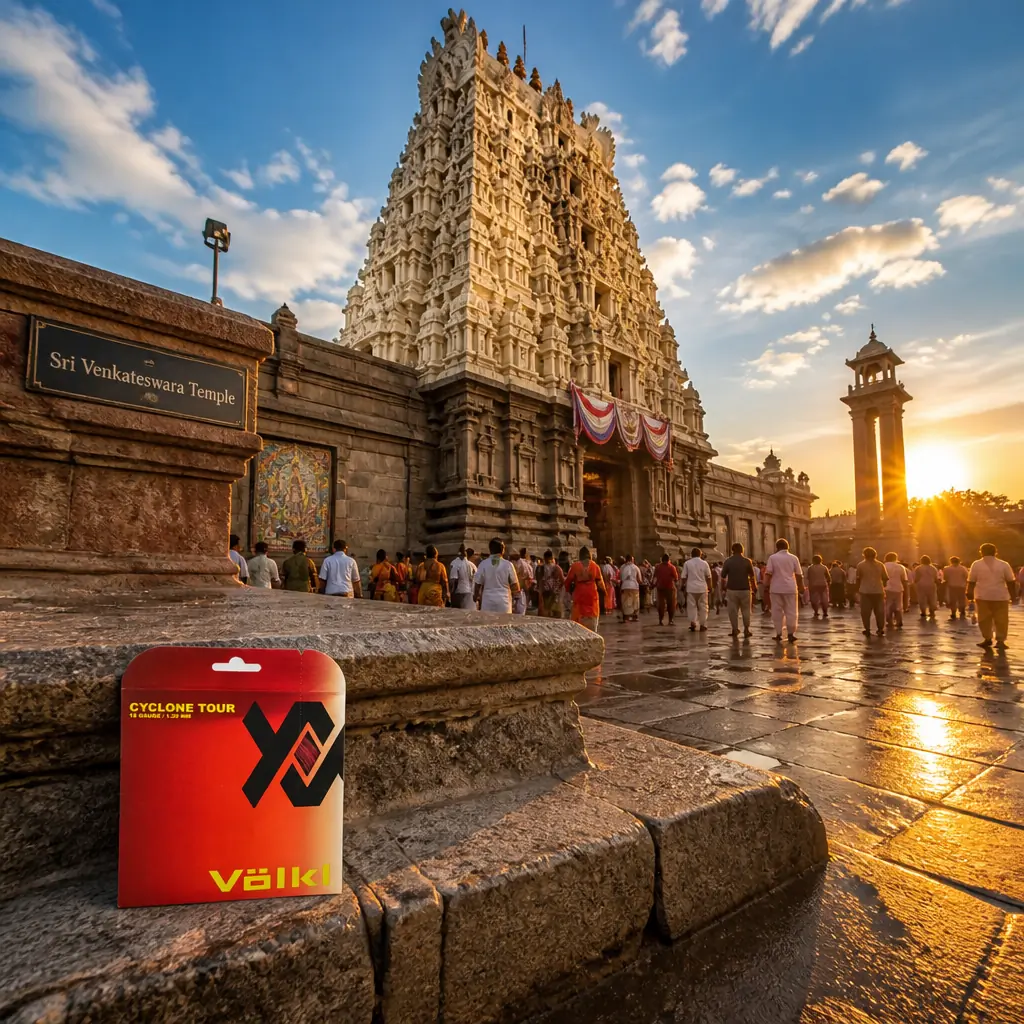
I was thinking about all of this while making my way through Tirupati, a city that knows something about the relationship between labour and glory. You walk toward Sri Venkateswara Temple and what strikes you, before the deity, before the doctrine, is the architecture. Someone cut that stone. Someone climbed that gopuram to set those carvings in place.
Generations of craftspeople whose names are not in any brochure. The same is true at Sri Govindaraja Swamy Temple, which sits in the lower town and tends to get overshadowed by its famous neighbour on the hill, which is, if you will permit me the observation, a very familiar dynamic.
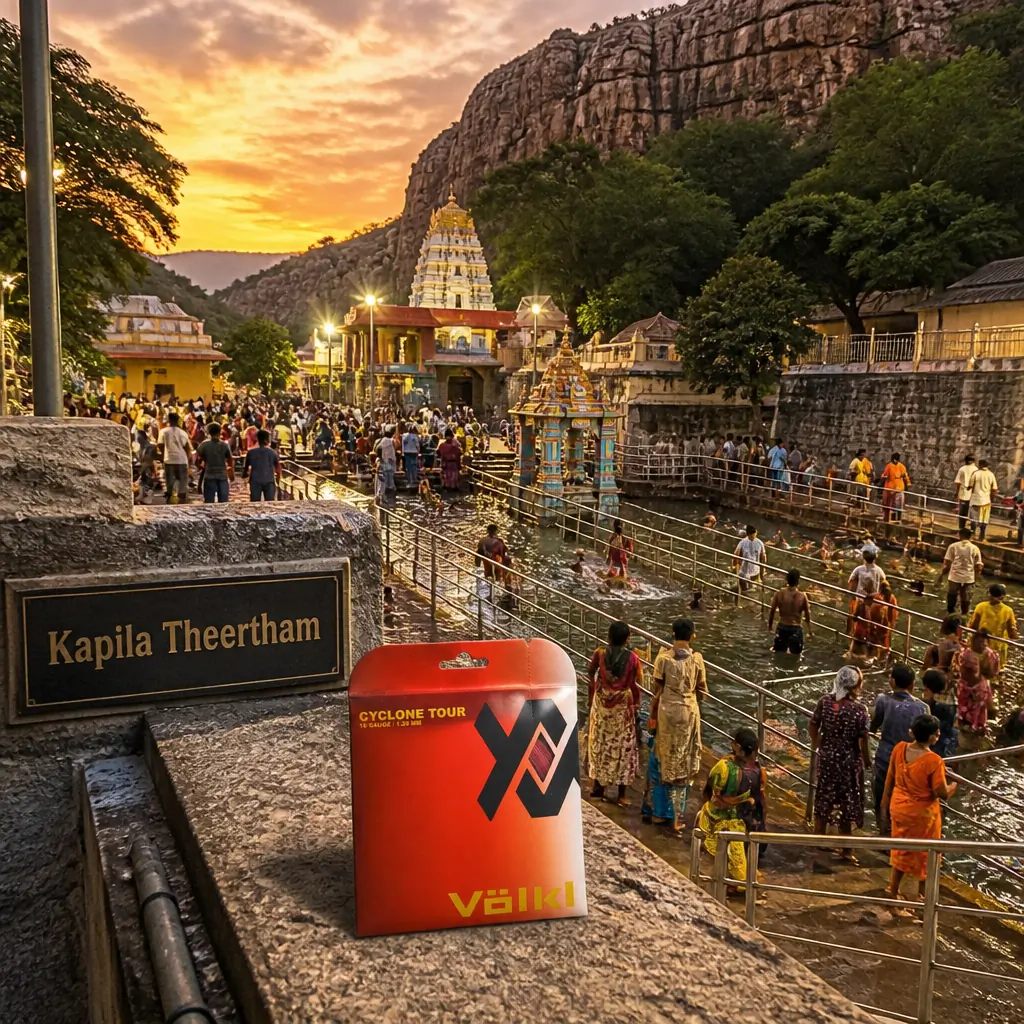
The celebrated institution draws the pilgrims; the workers who maintain it eat quietly elsewhere. At Kapila Theertham, where the waterfall meets the temple at the base of the hills, I watched a man repointing the stone path at six in the morning, before the crowds arrived, and I thought: that is the person this story is about.
And over at ISKCON Tirupati, the gardens are immaculate, the prasadam is abundant, and someone woke up before dawn to make that happen, and their name is not on the sign.
Back to the string, because the string is also a labour story. The Cyclone Tour 18g is a string for serious players, and serious players are often people who have put in unglamorous hours. Not the sponsor's box people. The people who hit a thousand balls on a Tuesday afternoon in a public park because they wanted to get better.
The people who, in a different context, might attend Fort Lauderdale themed cardiovascular tennis camps and come away fitter and hungrier and ready to finally commit to a proper polyester string instead of whatever multifilament compromise they have been sold by a shop assistant working on commission. This string rewards that commitment.
It is not the most arm-friendly option on the market, and I will not pretend otherwise, because polyester is stiffer than nylon or natural gut and if you have an elbow that objects to vibration you should string at a lower tension and perhaps consult a stringer who knows what they are doing, which brings us back, inevitably, to the stringer, who is a worker, and who should be paid well.
The tension recommendation will vary by frame and preference, but experienced polyester users often drop five to ten percent compared to their synthetic gut tensions to compensate for the lower elasticity.
The string has good durability relative to its gauge, which is on the thinner end, 18g being finer than the more common 17g or 16g, and finer strings generally offer more bite and feel while lasting somewhat less long than their thicker counterparts. That is the honest trade. Spin and feel against longevity.
A player who breaks strings regularly will go through sets of this, and someone will keep stringing them, and that person deserves acknowledgement and a fair hourly rate. I am cheerful about all of this. The string is genuinely excellent. I just want us to know who made it excellent.
Buy on Amazon